What the Model Context Protocol (MCP) means for government and education sales teams
The Model Context Protocol brings live buyer data into Claude and ChatGPT. Learn why it matters more for teams selling to government and education.

Government and education buying signals are scattered across budgets, board minutes, and procurement portals. The Model Context Protocol (MCP) brings connected data into the AI assistant reps already use. The advantage comes from the quality of the data behind those answers.
TL;DR: MCP for government and education sales teams
The Model Context Protocol (MCP) lets government and education sales teams connect AI assistants to external buyer data and tools. Reps can research accounts, identify buying signals, and prepare outreach using connected contact, budget, and contract records. The quality of those answers depends on the source’s coverage, freshness, and verification, so reliable data and access controls still matter.
What is the Model Context Protocol?
MCP is an open standard that gives AI models, apps, and agents one consistent way to connect to outside tools and data sources. The company Anthropic created it in-house and open-sourced it on November 25, 2024.
The problem MCP solves
Before MCP, every new AI tool needed its own custom connection to every system the team relied on. Anthropic named the problem at launch, noting that every new data source requires its own custom implementation.
In the sales context, imagine a sales team running four AI assistants and six sales tools.
Without a shared standard, each pairing needs its own integration, which adds up to 24 one-off builds to maintain. With MCP, each tool exposes one server, and each assistant speaks one protocol, so the build count drops to 10 protocol implementations, though the same 24 pairings may still connect.
For a sales leader, fewer custom integrations mean fewer brittle connections breaking the week before quarter close.
How MCP works without the jargon
MCP splits every connection into three roles. In a sales setup, Claude is the host where the rep types a question. Claude then creates one client for each MCP server, and a CRM or data provider runs the server that supplies the answer.
The official MCP docs compare the protocol to a USB-C port for AI applications. One standard plug replaces a drawer full of custom cables, so MCP-ready assistants and tools can connect, subject to supported features, transport, and permissions.
MCP servers commonly sit in front of existing APIs and add a layer designed for AI. Teams keep the APIs they pay for today. Google, for example, says its existing API infrastructure is now enhanced to support MCP.
Who backs MCP today
Adoption moved fast after launch, and the largest AI companies signed on within about a year. The table below lists the most relevant milestones for buyers:
| Date | Backer | Milestone |
|---|---|---|
| November 2024 | Block | Named an early adopter at MCP’s launch |
| March 2025 | OpenAI | Announced MCP support, starting with its Agents SDK |
| April 2025 | GitHub | Released an official GitHub MCP server in public preview |
| May 2025 | Microsoft | Made MCP generally available in Copilot Studio and announced native Windows support, in public preview as of November 2025 |
| December 2025 | Google Cloud | Launched fully managed, remote MCP servers for Google services |
Server growth kept pace, with Anthropic reporting more than 10,000 active public MCP servers as of December 2025.
On December 9, 2025, Anthropic donated MCP to the Agentic AI Foundation, a directed fund under the Linux Foundation. Anthropic, Block, and OpenAI co-founded the fund, and project maintainers still handle day-to-day decisions. For buyers, choosing MCP-ready tools no longer means betting on one AI company.
Why MCP matters more when your buyers are school districts, cities, and universities
Commercial sellers often have to infer buying intent from website visits and content downloads. Government and education buyers discuss theirs in open meetings and publish it in budgets and purchasing records.
The hard part is volume.
No rep can track thousands of districts, cities, and campuses by hand, and general AI models can’t read or refresh those sources on their own. MCP closes that gap by connecting the assistant to a source that can.
Live context instead of stale training data
Ask a general AI model about a district’s technology priorities without web search or connected tools, and it relies on training data with a cutoff date.
Anthropic notes that its models may not have accurate information about events after that cutoff.
An MCP-connected assistant can query operational data when the rep asks, with freshness determined by the source.
Freshness matters most for buying signals, the early signs of planned spending (such as a new grant or a contract about to expire). Buyers consult vendors early to learn what’s possible, and the vendor who educates them shapes the evaluation criteria. A rep who first hears about a project from the RFP arrives after the deal has taken shape.
Many of the richest buying signals come up in board meetings and budget sessions, and the full discussion often exists only as a video or audio recording that an assistant may not have indexed or transcribed. For new business, those discussions reveal live initiatives before an RFP exists. For existing customers, they flag renewal risk and expansion openings. Live context is only as useful as what the MCP server on the other end has captured.
What reps can do with Starbridge MCP inside Claude or ChatGPT
In practice, accessing the Starbridge MCP turns a morning of account research into a single prompt.
Before Monday’s pipeline review, a rep might ask Claude, “Which Texas districts discussed cybersecurity at board meetings this quarter, and who is the incumbent?” With the right MCP server connected, Claude answers from live records.
Four GTM workflows benefit first:
- Account research on priorities and recent board discussions
- Competitor mapping across a territory’s existing contracts
- Pre-call prep on spend history and incumbent vendors
- Contract expirations spotted 12 to 18 months out, plus active RFPs surfaced before the deadline crunch
The first three workflows cover research, while the fourth covers timing. Reps run all four without leaving the chat window.
Answering that Texas prompt well takes a source built for this market, and Starbridge MCP fills that role.
It connects Claude and ChatGPT to live intelligence on local government, K–12, and higher education accounts, including what was said in board meetings and budget sessions. Reps ask in plain language and get answers tailored to their products and market.
Your AI is only as smart as the data behind it
MCP passes data returned by connected sources, so an assistant fed stale or unverified contacts can give confident, wrong answers.
A government and education sales team should connect three data sources to its AI:
- Verified contacts for the people who own budgets and decisions
- Buying signals from board meetings, budgets, and grants
- Spend and incumbent vendor data from contracts and purchase orders
The CRM ties those sources together as the system of record.
Contacts are where most stacks break down. Contact databases focused on commercial profiles can miss government and education roles, and those records can go stale. Bounce rates vary by provider, target segment, and verification process, so test a sample of your own accounts. Every bounce wastes rep time, lowers deliverability, and weakens sequence performance.
Starbridge built Contacts & Company Data to solve that.
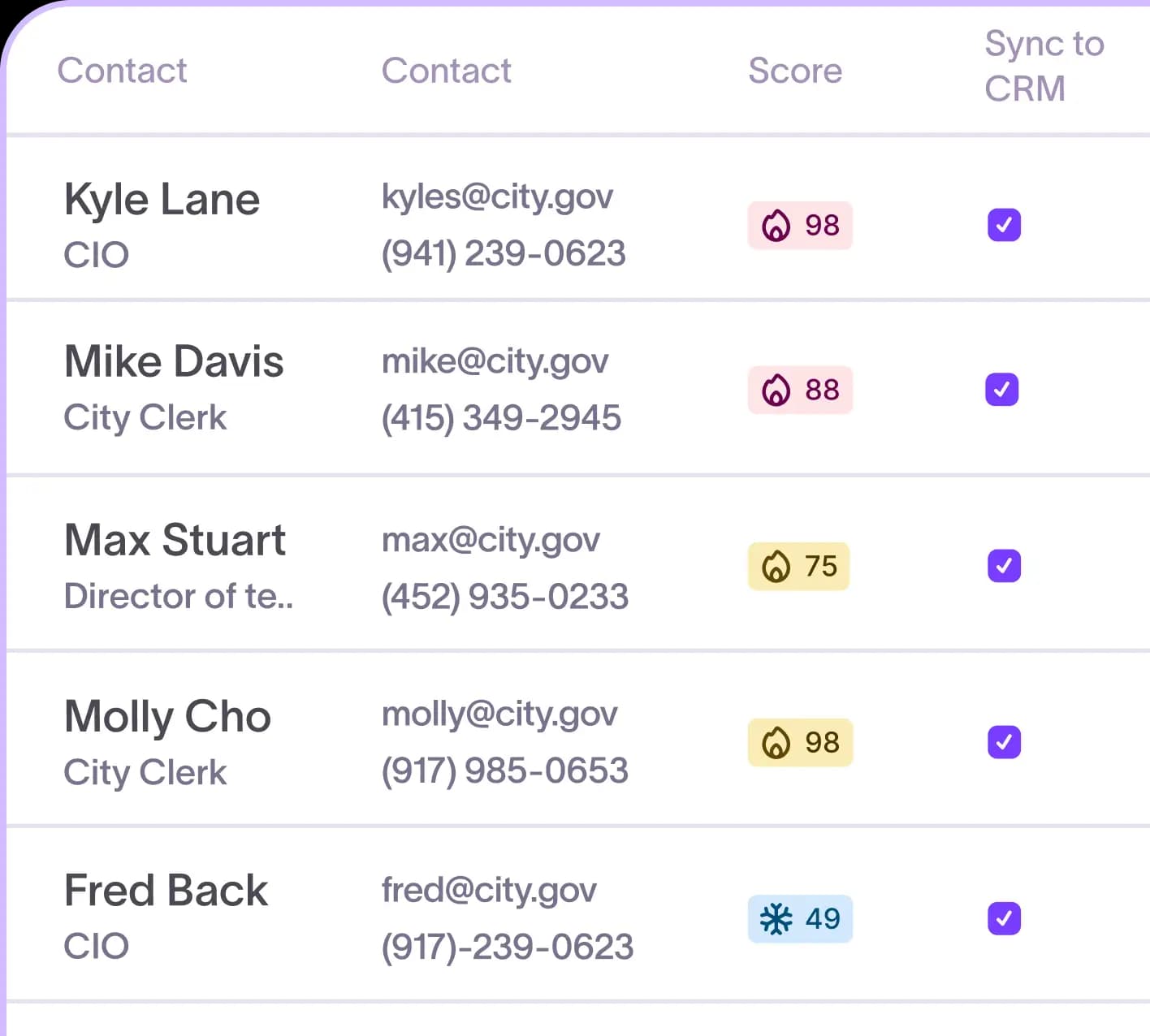
Its proprietary web-agent technology crawls government department sites, school district portals, and university websites. Waterfall enrichment and continuous bounce-checking verify each record before it syncs to the CRM.
That process reached 98% email accuracy on a 14,000-email test, compared with roughly 75 to 85% from generic databases. TAM to Target reports Starbridge contact data is 3 to 4x more valid than other vendors it has used.
The hype test for Model Context Protocol tools in the public sector
Is MCP new, or is it hype? The standard is real, and every backer in the adoption table above has shipped working support for it since launch.
The hype lives in the products on top, since plenty of MCP tools add a query box with no better data behind it.
Three questions to ask before buying an MCP tool
Chat-only answers stall because nothing happens after the rep reads them. Three questions show whether an MCP tool turns insight into execution.
- First, does the intelligence land in Salesforce or HubSpot, or does it stay trapped in a chat window? If the answer never reaches the CRM, it can remain disconnected from the shared account record.
- Second, does each answer come with a verified contact, a reason for outreach, and ready-to-send copy? Research without a next step leaves the hardest part to the rep.
- Third, do buying signals reach Apollo, Outreach, or Slack without CSV imports? Reps work across many apps, and every manual export lets a buying signal go stale before anyone acts.
Starbridge covers all three through the platform behind its MCP connection. Native, bi-directional Salesforce and HubSpot integrations sync signals and enriched records into the CRM with no engineering required. Each signal from the Buying Signal Monitor arrives with a verified contact, a reason for outreach, and AI-generated copy, and the Monitor pushes signals to Apollo, Outreach, and Slack.
GovWell, for one, sources 15% of its qualified pipeline from Starbridge.
Adoption without an engineering ticket
Non-technical revenue teams can connect MCP tools in minutes through the assistant’s connector settings.
In Claude, owners on Team and Enterprise plans add custom connectors, and members then connect individually. In ChatGPT, custom MCP servers connect through developer mode, with availability governed by account and workspace policy.
Plan details change often, so confirm settings before rollout. Sales ops or a GTM engineer should own the setup and the prompts reps reuse. A GTM engineer is the scrappy operator who writes sharp copy and builds AI-driven outbound plays.
What MCP doesn’t change about security and governance
MCP defines how AI apps connect to tools, and your organization still owns identity, auditability, and human approval for write actions. The NSA’s May 2026 guidance says MCP’s security posture remains uneven and highly dependent on implementation discipline.
The core risks are weak authentication and authorization, prompt injection, and unintended data exposure. The OWASP MCP Top 10, still a beta project, covers all three. Microsoft also warns that malicious MCP servers can expose customer data in ways organizations don’t expect.
Governance carries extra weight when buyers are risk-averse school districts and cities. IT teams there often make the final call and review every vendor in the chain, including the tools behind a seller’s outreach. Put these questions to every MCP vendor before connecting:
- Which access controls limit what the assistant can read and write?
- How is customer data stored and logged?
- Which independent audits back up those answers?
On that last question, Starbridge is SOC 2 Type II certified. That means an independent auditor verified its security, availability, and confidentiality controls held up over an extended audit period, giving IT reviewers proof rather than promises.
Data quality decides what MCP is worth to your reps
MCP settles how an assistant reaches your data. It doesn’t decide whether that data is any good. As more teams selling to government and education connect Claude or ChatGPT to their tools, the assistants will start to look alike, and the sources behind them will set one team apart.
Start with an audit of every data source feeding your team’s AI today. Run each one through the three hype-test questions and the governance checklist, and cut the ones that fail. What’s left should give reps verified contacts, early buying signals, and spend data, all tied back to the CRM.
The hardest gaps to fill are usually the sources general AI can’t reach on its own, such as board meeting recordings, district portals, and contract records spread across thousands of sites.
That’s where Starbridge comes in. As the AI GTM platform built on the most comprehensive dataset of government and education buyers and buying signals, Starbridge helps companies selling to local government, K–12, and higher education identify, prioritize, and engage high-intent opportunities before the competition. It carries each deal from the first buying signal through procurement to a signed contract.
Book a demo to see Starbridge MCP answer live account questions inside Claude or ChatGPT and help your team win more deals.
Frequently asked questions
MCP servers commonly sit in front of existing APIs and add a layer designed for AI assistants. Teams keep their APIs and gain a standard way for AI to use them.
MCP’s security depends on how each vendor implements identity and approvals. The NSA’s May 2026 guidance treats security as implementation-dependent, so ask vendors about access controls, data handling, and independent audits. Starbridge answers the audit question with its SOC 2 Type II certification.
Claude supports custom connectors built on remote MCP servers, and ChatGPT supports custom MCP servers through developer mode, subject to account and workspace policy. Anthropic reported in December 2025 that Gemini, Microsoft Copilot, and Cursor had also adopted MCP. Plan availability changes often, so check admin settings before rollout.
Starbridge MCP connects Claude, ChatGPT, and other MCP-compatible assistants to Starbridge’s intelligence on local government, K–12, and higher education accounts. Reps can pull buying signals, board meeting discussions, contract expirations, active RFPs, spend data, and verified contacts without leaving the assistant.
On its own, a general AI model answers from training data and public web pages, which often means outdated names and generic summaries. Starbridge MCP answers from Starbridge’s dataset instead, including board meeting discussions, purchasing and contract records, and contacts verified to 98% email accuracy.
Explore our use case library
 Automate account research with AI agentsStop manually researching accounts. Starbridge AI agents automate account research by monitoring buying signals 24/7 and surfacing the right contacts.
 Identify competitor contract expiration datesThe RFP is usually a formality. Starbridge surfaces competitor contract expiration dates so your reps reach accounts before the renewal cycle closes.
 Create a conference campaignTurn conference badge scans into pipeline. Import your contact list, surface buying signals across every account you met, and follow up with context.