What Q4 government spending means for local government and schools
The year-end spending rush works differently for local government and schools. See what Q4 government spending really means and when budgets free up.

The federal year-end rush is real, but it runs on a fiscal calendar that most states and many school districts and universities don’t use.
This article breaks down where the federal story comes from, why it falls apart for local government and schools, and how to read each account’s real budget timing.
TL;DR: Timing outreach to each buyer’s fiscal year
Q4 government spending depends on the buyer’s fiscal calendar. Federal Q4 runs July through September, while buyers with a June year-end reach fiscal Q4 from April through June. Calendar Q4 is not a universal spending deadline. Check each account’s budget, funding expiration, and purchasing cutoffs. Then use public buying signals and verified contacts to time outreach around actual needs and available funds, rather than assuming every account faces urgency.
Where the Q4 spending surge comes from on the federal calendar
The federal fiscal year runs October 1 through September 30. That makes federal Q4 the July-through-September stretch, the government’s highest-activity obligation period. Most of what sellers believe about year-end spending traces back to this window.
The driver is "use-it-or-lose-it." Most appropriated federal funds expire at fiscal year-end on September 30. Agencies that leave money unspent lose it and risk a smaller budget next year, so they obligate fast before the deadline.
The concentration is steep. According to a landmark study published by the National Bureau of Economic Research, federal contract spending in the final week of the fiscal year skyrockets to nearly five times the weekly average of the rest of the year. To move that much money quickly before the September 30 deadline, federal buyers lean heavily on fast award channels:
- Simplified acquisitions for smaller purchases
- IDIQ and GWAC task orders against existing contracts
- GSA Schedule orders
- Set-asides for eligible vendors
So the Q4 federal spending rush exists. However, the calendar and procurement rules differ across state and local government, K-12, and higher education buyers.
Why the year-end surge story falls apart for local government and schools
Selling goods and services to state and local government, K–12, and higher education means selling to a different calendar entirely.
46 states, along with many school districts and universities, run a July-to-June fiscal year.
Their new budget starts in the summer, not October.
October through December, the fourth quarter of the calendar year, is their second fiscal quarter. So approved funds may already be allocated or committed.
For accounts that close on June 30, fiscal Q4 is April through June, so urgency depends on funding expiration, carry-forward rules, and internal purchasing cutoffs.
Selling to the wrong calendar has a cost. Reps call accounts at the dead point of the cycle and misread how urgent a deal really is. They may chase a December deadline that does not apply and miss the account’s actual purchasing window.
What calendar Q4 really means for your accounts
Budget planning and newly funded projects can open an engagement window. Buyers are deciding where new money goes before any RFP is published. A rep who shows up during that window can help clarify needs through permitted channels before requirements are finalized.
Map each account’s fiscal calendar before you build the outreach plan
Before you sequence a single email, confirm which clock each account runs on.
July starts are common, but calendars vary by entity. Some cities and counties use October, January, or other start dates.
The answer changes when your message should land.
Confirm the calendar from public records:
- Board budget adoption dates in meeting minutes
- Published annual budget documents
- Posted fiscal-year calendars on district and agency sites
Prioritize verified needs, funding availability, and purchasing timelines; engage before budget adoption when planning for the next cycle.
Two districts can look identical on paper and need opposite timing.
A district that adopted its budget in June may have funded projects to discuss in the fall. A district that adopts in December may benefit from engagement during budget planning, as well as after approved funding becomes available.
Read the early buying indicators that appear before the RFP
Reps who wait for the RFP can miss earlier opportunities to understand buyer needs.
By the time a solicitation posts, the buyer may already have researched options and defined its evaluation criteria.
That’s why experienced B2G sellers use buying signals that surface before an RFP ever appears.
These public indicators can suggest potential needs and funding:
- Board discussions and agenda items
- New budget line items
- Grant awards
- Leadership changes tied to purchasing authority
- Contract expirations
The problem? Finding these by hand is a laborious process and does not scale across thousands of accounts.
That’s one of the reasons we’ve created Starbridge.
Starbridge’s Buying Signal Monitor surfaces buying signals automatically.
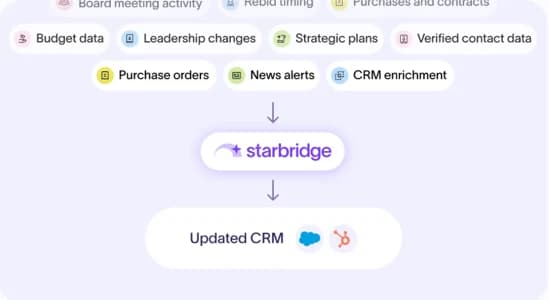
It draws on a comprehensive dataset of public-sector buyers and buying signals, so teams can act on potential buying intent before an RFP; lead times vary.
Accounts can be scored, prioritized, and routed to reps with the supporting evidence.
That early window is often where deals are won.
InquirED, for example, used adoption intelligence to replace manual research and generated $200,000 in new pipeline in its first quarter.
How to find which districts, agencies, and institutions have budget to spend
Knowing about the federal year-end spending surge doesn’t help unless reps know whether buyers have budget.
That information is scattered across procurement portals, board minutes, and budget PDFs. Reps default to geography or account size because pulling it together by hand takes hours per account.
Starbridge’s Public Spend Intelligence combines purchase orders, FOIA-sourced contracts, and web intelligence to reveal vendor spend and contract details.
It surfaces current spend, incumbent vendor, and contract expiration dates, including competitor contracts nearing renewal for rip-and-replace timing. Then it ranks the full TAM on 100+ buying indicators through dynamic account scoring.

Ask Starbridge Chat pulls that account context in seconds, so a rep sees current spend and the incumbent without opening a portal.

Frontline Education cut account research time 90%, from about 2 hours to 5 minutes per account.
Zencity now sources half its cold meetings from Starbridge.
Reps walk into discovery already knowing what a buyer spends and who the incumbent is, so the conversation starts at the problem, not the introduction.
How to reach the right buyer before the spending window closes
For accounts with a June 30 year-end, spring purchasing cutoffs can create a short window.
Outreach that starts too late, or lands on the wrong person, misses the buying window entirely. Two things protect that window: current contact data and a fast path from signal to sent message.
Protect a short window with accurate, current contact data
Contact data in government and education goes stale fast. Budget-year and election-cycle turnover reshuffles staff, and B2B databases can have gaps in coverage of these buyers because they may rely heavily on LinkedIn scraping.
This is a problem, because in a finite TAM where reputation travels, one misfired email to someone who left two years ago can burn a relationship.
Engaging the right contacts with confidence starts with verified records.
Starbridge’s Contacts & Company Data crawls .gov and .edu sites, staff directories, and board minutes, then regularly bounce-checks records and can sync them to your CRM.
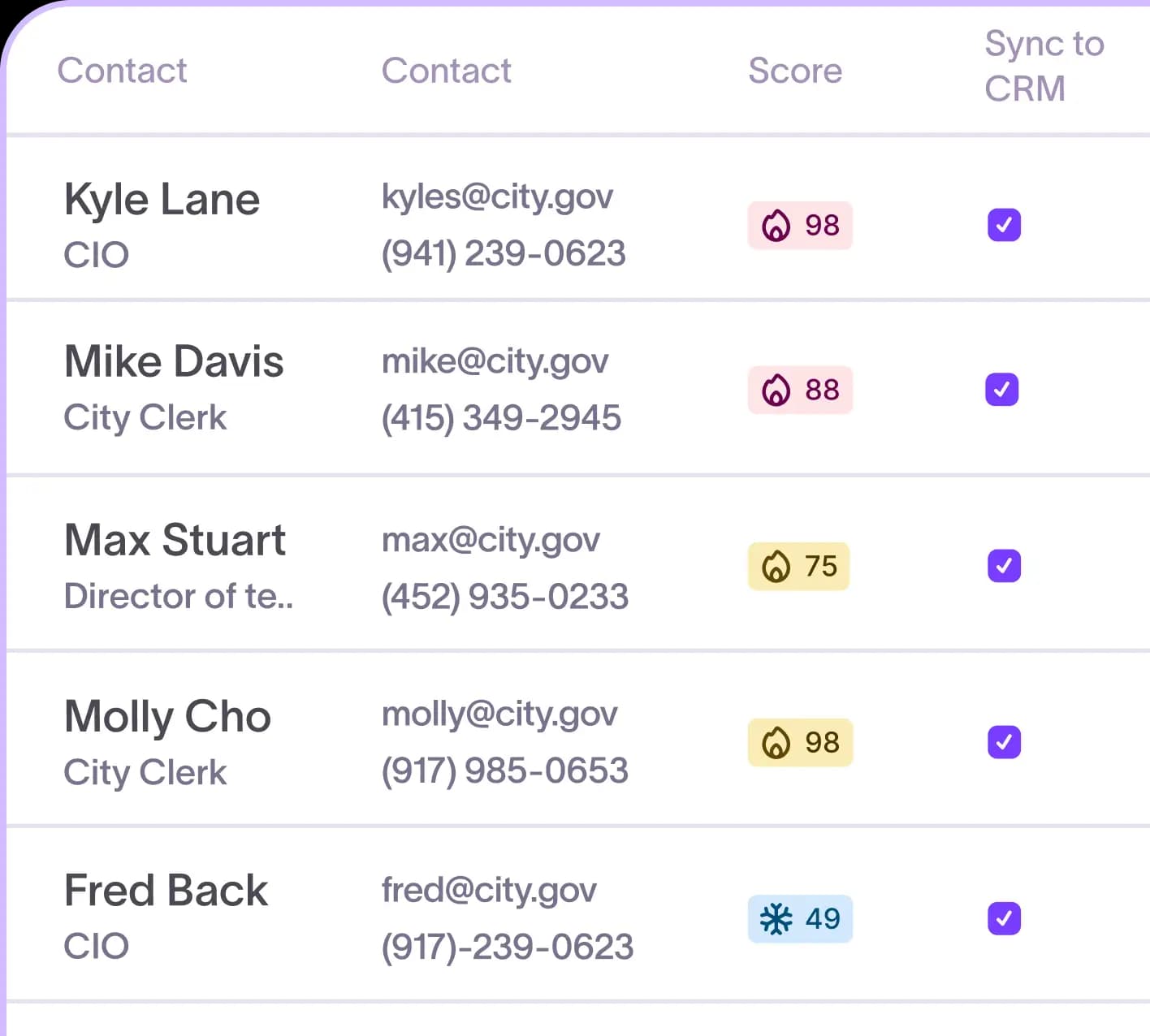
Reps can spend less time verifying contacts and more time acting on them.
The accuracy gap is measurable. Starbridge delivered 98% email accuracy on a 14,000-email test with a 2% bounce rate, against a 15% to 25% bounce rate from generic databases.
In a side-by-side review, TAM to Target found Starbridge contact data 3 to 4 times more valid than other vendors.
Turn budget-cycle timing into booked meetings
Most sales tools stop at a dashboard, with sales reps needing to dig through data to find the right people to contact today.
During the busiest weeks of the cycle, that leaves reps spending a good chunk of their day on account research rather than selling and closing contracts.
Starbridge solves that by surfacing selected buying indicators as prioritized, territory-level alerts and digests.

Every alert arrives with a verified contact, the reason for outreach, and AI-generated copy ready to send. Alerts push into Salesforce, HubSpot, Apollo, and Outreach, so reps act the same day instead of stitching tools together.
Sell to each account’s own budget calendar
Q4 government spending only looks like a massive surge if you’re selling to federal buyers.
Winning teams selling to state and local government, school districts, and higher education are mindful of each account’s own budget calendar.
See how Starbridge surfaces budget timing and buying indicators across your TAM so you engage the right accounts before the window closes. Book a demo.
Frequently asked questions
Federal Q4 runs July through September, the last quarter of a fiscal year that ends September 30. One driver is that annual appropriations generally expire for new obligations at year-end; multiyear and no-year funds differ. The size of the concentration varies by year and agency.
Not necessarily. Forty-six states and many school districts and universities run July-to-June fiscal years; other public buyers use different calendars. For July-start accounts, calendar Q4 is fiscal Q2; the actual availability and expiration of funds depend on the budget and funding source.
For institutions with a June 30 fiscal year-end, fiscal Q4 runs April through June. Spring can bring purchasing cutoffs for expiring funds, but carry-forward rules, grant terms, and internal deadlines determine the urgency.
Check public records: board budget adoption dates in meeting minutes, published annual budget documents, and posted fiscal-year calendars. Those help establish the account’s actual fiscal year and budget-adoption schedule; also confirm purchasing cutoffs. Starbridge structures this timing across your TAM so you can treat it as a buying signal.
Start with approved budgets and current financial reports, then confirm available, uncommitted funds with finance or procurement; published budgets alone do not show today’s balance. Starbridge’s Public Spend Intelligence structures that data and ranks your TAM on 100+ buying indicators, so reps pinpoint approved money instead of guessing.
Explore our use case library
 Automate account research with AI agentsStop manually researching accounts. Starbridge AI agents automate account research by monitoring buying signals 24/7 and surfacing the right contacts.
 Identify competitor contract expiration datesThe RFP is usually a formality. Starbridge surfaces competitor contract expiration dates so your reps reach accounts before the renewal cycle closes.
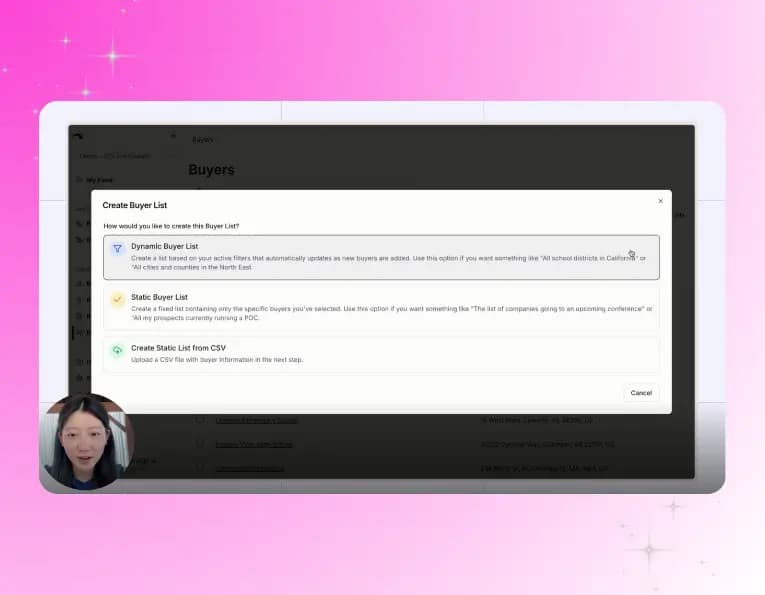 Create a conference campaignTurn conference badge scans into pipeline. Import your contact list, surface buying signals across every account you met, and follow up with context.